As light as aluminum and stronger than steel, carbon fiber is redefining the performance ceiling for drones.
With drone technology evolving rapidly—from agricultural pest control to logistics and delivery, and from military reconnaissance to emergency rescue—the choice of materials directly determines the upper limit of flight performance. Among the many available options, carbon fiber composites have become the top choice for mid- to high-end drones thanks to their unique performance advantages.
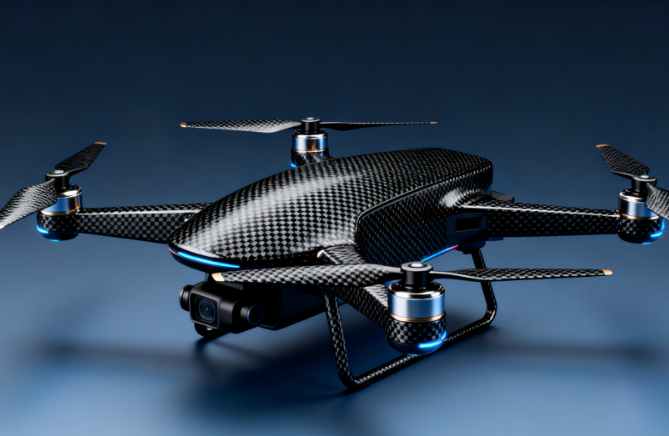
Lightweight Design: A Dual Breakthrough in Range and Payload
The flight endurance and payload capacity of drones have always been limited by structural weight, and the density advantage of carbon fiber has become the key to breaking this impasse. The density of carbon fiber composites is only 1.5–1.6 g/cm³, which is equivalent to 54% that of aluminum alloy and 20% that of steel.
The benefits of this weight reduction are immediately apparent: multirotor drones with carbon fiber airframes weigh 25%–30% less than aluminum alloy counterparts, and their flight time is extended by 20%–25% with the same battery capacity. The U.S. “Global Hawk” unmanned reconnaissance aircraft achieved an exceptionally long flight time of 40 consecutive hours by using carbon fiber for more than 65% of its structure.
Even more noteworthy is that carbon fiber’s specific strength (strength per unit density) reaches 785 × 10⁷ cm, which is 6.8 times that of aluminum alloy and 10.3 times that of titanium alloy. This means that, for the same weight, carbon fiber can withstand greater load pressures. Practical experience from a drone company in Guangzhou shows that by increasing the proportion of carbon fiber materials to 92%–95%, its industrial drones can carry 100 kilograms more cargo than other models of the same size, achieving stable flight with a payload of 300 kilograms.
High Rigidity: Ensuring Stability in Challenging Environments
The reliability of drones in complex environments depends largely on the structural rigidity of the airframe material. The specific stiffness (stiffness per unit mass) of carbon fiber composites reaches 113 × 10⁷ cm, far exceeding that of aluminum (26 × 10⁷ cm) and titanium (25 × 10⁷ cm).
Test data shows that when subjected to airflow impacts at 120 kilometers per hour, the maximum deformation of a carbon fiber wing is only one-third that of an aluminum alloy wing, ensuring precise control of flight attitude. In high-altitude, high-wind environments, surveying drones with carbon fiber airframes can operate stably, whereas models made of traditional materials experience a decline in data accuracy of more than 20% due to structural vibrations.
Process Innovation: From High-End Customization to Mass Production
The maturation of advanced molding processes is driving the large-scale adoption of carbon fiber airframes. Using a 2,500-metric-ton press, the compression molding process can complete the one-piece molding of a drone airframe in just 10 minutes, boosting production efficiency by eight times compared to traditional methods.
Even more exciting is the breakthrough achieved in continuous carbon fiber 3D printing technology. The FS25e—the world’s first composite-wing UAV based on this technology—has successfully completed its maiden flight. Its integrated wing-fuselage-arm skeletal structure has significantly reduced both the manufacturing cycle and costs. This technology addresses the challenge that existing composite forming processes face in achieving high-performance, integrated forming of complex structures, substantially improving material utilization while effectively shortening manufacturing and assembly cycles.
In the field of large-scale drones, the domestically produced 7-metric-ton transport drone “Changying-8” consists of more than 80% composite materials, achieving 100% domestic supply for its composite system. Its wings utilize a monolithic co-curing process, which significantly reduces assembly seams and stress concentrations while enhancing structural strength and stability.
The Future Is Here: New Possibilities for Carbon Fiber
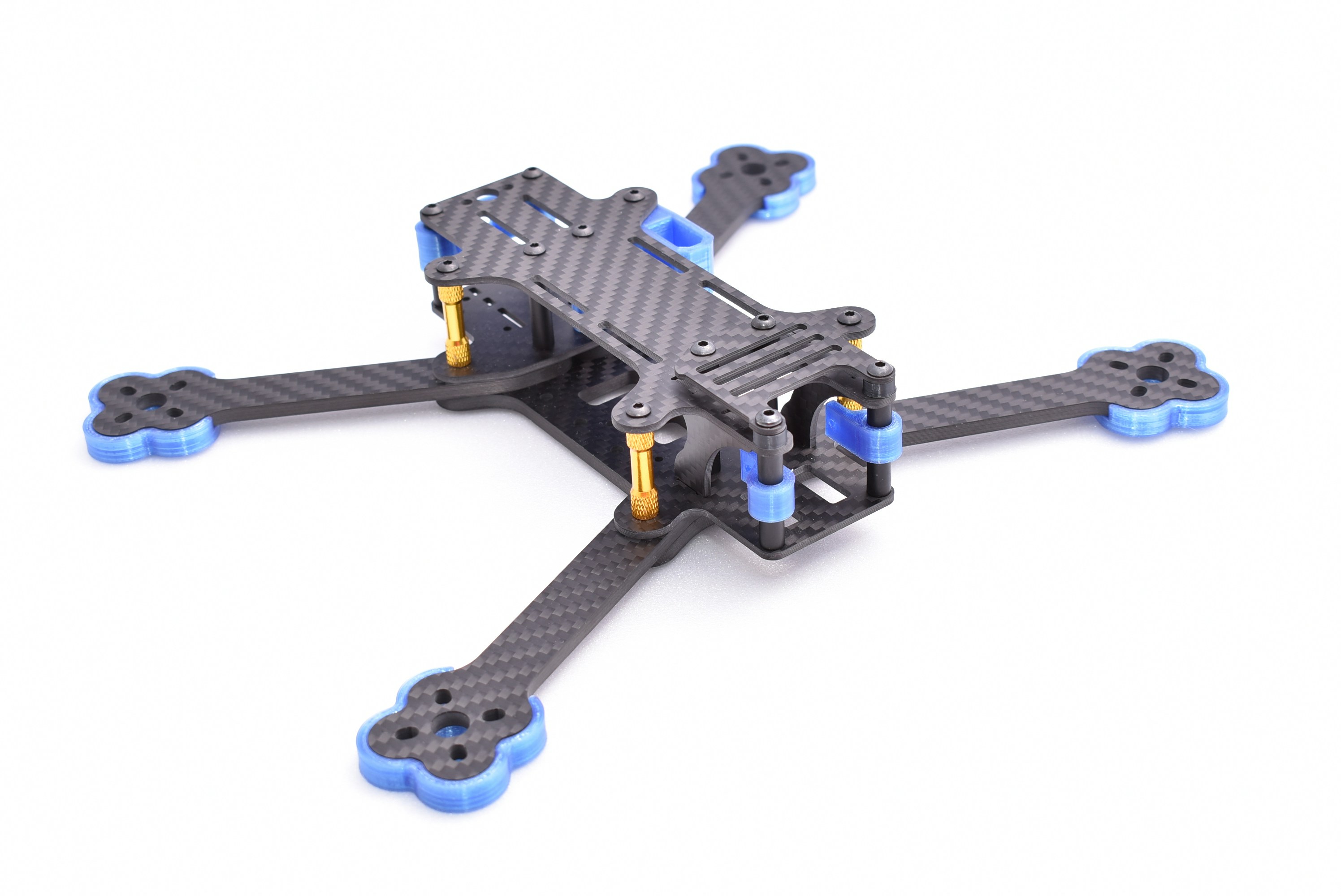
With the stable mass production of domestically produced T1000-grade carbon fiber—which boasts a tensile strength exceeding 6,600 megapascals and can withstand a force of approximately 200 kilopascals per meter—China’s self-reliance and control over high-end aerospace materials have been further strengthened.
Even more promising is the new carbon fiber-structured supercapacitor developed by a team at Nanjing University of Aeronautics and Astronautics, which is expected to enable drones to achieve the concept of “the airframe as the battery.” This will enable the airframe structure itself to store energy without adding the weight of additional batteries, thereby completely resolving the dilemma that drones face—the trade-off between flight endurance and payload capacity.
From material substitution to design concept innovation, carbon fiber composites are becoming a key driver of performance breakthroughs in drones, propelling this emerging industry from technological exploration toward commercial implementation and providing more efficient and reliable aerial solutions for logistics, agriculture, emergency response, and other fields.
Copyright © 2026 Zhangjiagang Weinuo Composites Co., Ltd. All rights reserved
 EN
EN