Hailed as "black gold," they serve as the wings enabling aircraft to soar with grace, the skeletal framework powering supercars to blistering speeds, and the mighty arms of wind turbine blades harnessing the wind's energy. Carbon fiber—this high-performance material stronger than steel yet lighter than aluminum—is permeating the fabric of modern industry at an unprecedented pace. Yet behind this materials revolution lies an increasingly urgent question for the future: Where will these costly composites end up after fulfilling their purpose? Will they become permanent waste, or embark on a new life cycle?
Today, we stand at a pivotal turning point—carbon fiber recycling and green manufacturing have swiftly evolved from laboratory research into industrial reality.
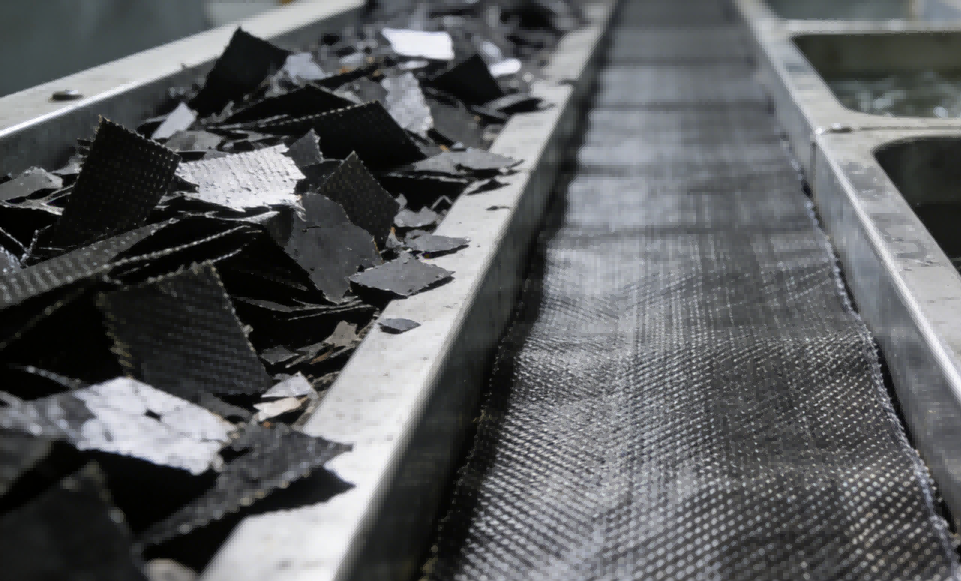
Breaking the Mold: The Shift from "Linear Consumption" to "Circular Regeneration"
Traditionally, carbon fiber composites—particularly thermoset carbon fiber, which dominates the market—have been deemed "non-recyclable" due to their cross-linked polymer structure. Discarded wind turbine blades lie buried underground, retired aircraft components sit idle, and piles of scrap material remain untouched. This represents not only a massive waste of resources—carbon fiber production itself consumes enormous energy, accounting for approximately 60% of its total cost—but also runs counter to global "dual carbon" strategies and circular economy goals.
The call for change has sounded. From the EU's Green Deal to China's "3060" dual carbon targets, stringent environmental regulations and extended producer responsibility systems are compelling the entire industry chain to rethink the "full lifecycle" of materials. What truly drives industry action, however, extends beyond environmental pressure to a recalculation of economic fundamentals: recycled carbon fiber costs just 30%-50% of virgin fiber while retaining 70%-90% of its superior properties. Turning waste into treasure has evolved from an ethical choice into a shrewd business decision.
Pioneering Pathways: The Race and Current Progress of Three Major Technologies
Currently, the three primary technical approaches for carbon fiber recycling have emerged from laboratories and are now competing head-to-head on the industrialization track.
1. Pyrolysis Method: The Current Industry Mainstay
This is the most mature and commercially advanced technology available. It operates by decomposing the resin matrix into oil and gas under high temperatures (400-700°C) in an oxygen-free or low-oxygen environment, leaving behind clean carbon fibers. Global leaders such as ELG Carbon Fibre (UK) and Vartega (US) have achieved stable mass production.
→Current Progress:
Carbon fiber recovered via pyrolysis has successfully been "downsized" for applications in automotive interior components, electronic device casings, and structural reinforcement materials—areas with slightly lower performance demands. This method has established the first closed-loop system from waste collection and recycling to product application, proving the viability of its business model.
2. Solvent Decomposition Method: The "Promising Prospect" for High-Value Recovery
This method employs specialized solvents to selectively dissolve resin under relatively mild conditions. It not only recovers fibers but also attempts to recover resin monomers or chemical feedstocks, maximizing value.
→Current Progress:
Though not yet widely deployed, this technology is viewed as a next-generation solution. In recent years, breakthroughs by startups and research institutions have led to the establishment of pilot production lines. Its greatest appeal lies in better preserving the original fiber structure and surface properties, making it promising for higher-value applications in the future.
3. Mechanical Method: The Simple and Direct "Practical Approach"
Through physical processes like crushing and grinding, composite materials are converted into chopped fibers or powders, which can be added as reinforcements to new plastics or concrete.
→Current Progress:
This method has the lowest barrier to entry and is the easiest to rapidly scale. While the resulting products have lower value, their strength lies in high throughput and low cost, offering a practical solution for massive volumes of low-value composite waste (e.g., consumer electronics casings).
Integration: How Green Manufacturing Reshapes the Future from the Source
Recycling is an end-of-pipe solution, while the true green revolution is unfolding at the source of manufacturing. This is the rise of thermoplastic carbon fiber composites.
Unlike traditional thermosetting resins that become irreversible once cured, thermoplastic resins (such as PA and PEEK) can be repeatedly heated, melted, and reshaped. This means:
(1) Production scraps can be immediately reprocessed, enabling near-zero-waste manufacturing.
(2) End-of-life products can be directly melted and re-molded, simplifying the recycling process and minimizing value loss.
Despite technical challenges like high-temperature processing, thermoplastic carbon fiber has begun large-scale application in new energy vehicles, consumer electronics, and other sectors. Together with recycling technology, it forms the "dual wings" of carbon fiber's green future: one wing handles "end-of-life recycling" to digest existing stockpiles, while the other wing employs "source-based plasticity" to reduce new waste generation.
Challenges and the Future: Gaps Yet to Be Bridged on the Path to a Closed-Loop System
The vision is ambitious, but reality remains stark. Building a complete circular economy ecosystem for carbon fiber still requires overcoming several critical hurdles:
→Stable Waste Supply Chain:
How to efficiently and economically collect, sort, and transport dispersed carbon fiber waste represents the first major challenge for industrialization.
→Balancing Performance and Market Demand:
While recycled carbon fiber maintains good performance, it exhibits certain degradation and variability. Establishing unified quality standards and developing stable markets that fully accommodate its performance characteristics will take time.
→The Cost Game Across the Entire Supply Chain:
Only when the comprehensive cost of recycling and regeneration consistently and significantly undercuts virgin fiber, coupled with achieving sufficient economies of scale, will the market truly accelerate.
Carbon fiber recycling and green manufacturing have evolved beyond theoretical debates about "feasibility" into a practical race for "better and more economical implementation." This represents a profound transformation driven by environmental regulations, economic logic, and technological innovation.
This signifies that in the future, carbon fiber will no longer be merely a synonym for "high performance," but a benchmark for "sustainability." From aircraft wings to laptop casings, the advanced materials we use may carry the memory of a past life, preparing for their next rebirth. This is not just the cycle of materials, but a microcosm of humanity's industrial civilization moving toward harmony with nature. Black fibers are weaving a green future.
Copyright © 2026 Zhangjiagang Weinuo Composites Co., Ltd. All rights reserved
 EN
EN