
 EN
EN

When selecting carbon fiber fabrics for composite manufacturing, understanding the structural differences between weave patterns becomes critical for achieving optimal performance characteristics. The comparison between twill weave carbon fiber and plain weave carbon fiber involves examining fundamental aspects of fiber architecture, mechanical properties, and manufacturing considerations that directly impact end-product quality and application suitability.
The structural distinction between these two weaving patterns creates measurable differences in drapeability, surface texture, weight distribution, and resin flow characteristics during composite fabrication processes. While both weave types utilize identical carbon fiber filaments, their interlacing patterns generate unique performance profiles that make each suitable for specific industrial applications and manufacturing requirements.
Structural Architecture and Weaving Pattern Differences
Plain Weave Construction Characteristics
Plain weave carbon fiber represents the most fundamental weaving pattern where warp and weft fibers alternate in a simple over-under sequence. This creates maximum fiber interlacement frequency with each warp fiber crossing over one weft fiber and under the next in a consistent checkerboard pattern. The tight interlacement results in excellent structural stability and minimal fiber movement during handling operations.
The geometric configuration of plain weave produces relatively high crimp angles as fibers bend around each intersection point. This frequent undulation creates a fabric with maximum dimensional stability but also introduces stress concentrations at crimp points that can influence mechanical performance under specific loading conditions.
Plain weave fabrics exhibit balanced properties in both warp and weft directions due to the symmetrical interlacement pattern. The tight weave structure creates a relatively stiff fabric with excellent shape retention characteristics, making it particularly suitable for applications requiring precise dimensional control during composite manufacturing processes.
Twill Weave Architectural Features
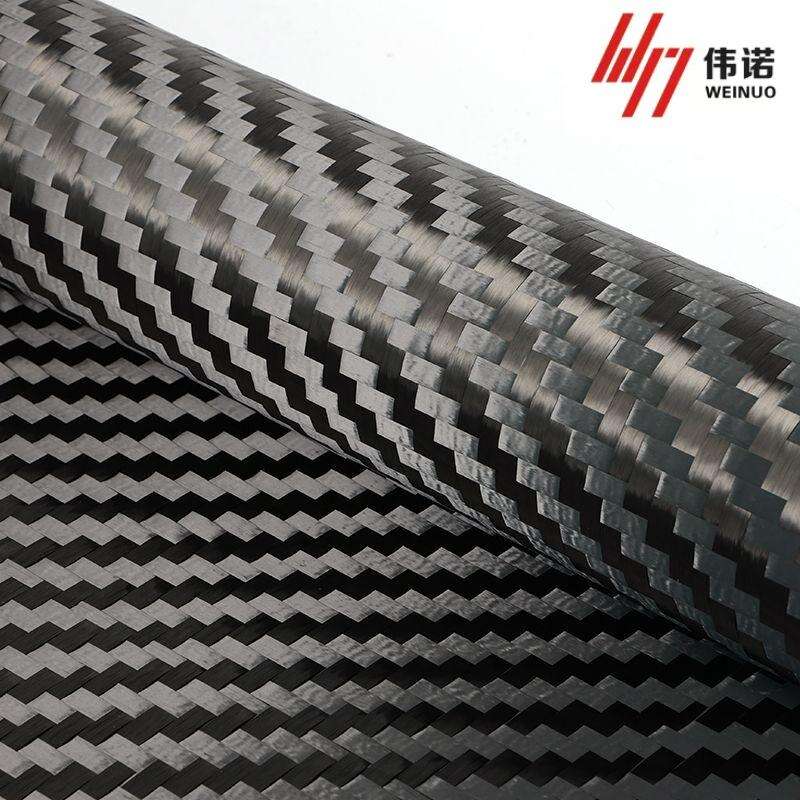
Twill weave carbon fiber utilizes a diagonal interlacement pattern where warp fibers pass over two or more weft fibers before going under one, creating the characteristic diagonal line appearance. The most common configuration is a 2x2 twill pattern, though variations like 3x1 and 4x4 twill are also utilized depending on specific performance requirements.
The reduced interlacement frequency in twill weave carbon fiber results in longer float lengths where fibers travel greater distances without crossing over adjacent fibers. This architectural difference creates lower crimp angles compared to plain weave, allowing fibers to maintain straighter paths and potentially higher mechanical efficiency in primary loading directions.
The diagonal weave pattern in twill weave carbon fiber produces enhanced drapeability characteristics, enabling the fabric to conform more readily to complex curved surfaces during composite layup operations. This improved conformability comes from the reduced interlacement constraints that allow greater fiber mobility and deformation capability.
Mechanical Performance Comparison
Strength and Stiffness Characteristics
The mechanical performance differences between twill weave carbon fiber and plain weave result primarily from their distinct crimp patterns and fiber orientation efficiency. Plain weave fabrics typically exhibit slightly lower in-plane tensile strength due to higher crimp angles that introduce fiber undulation and stress concentrations at interlacement points.
Twill weave carbon fiber generally demonstrates superior tensile strength properties in primary loading directions due to reduced fiber crimp and straighter fiber paths. The longer float lengths allow fibers to carry loads more efficiently without the frequent directional changes imposed by tight plain weave interlacement patterns.
Interlaminar shear strength characteristics can vary between the two weave types depending on specific resin systems and processing parameters. The tighter interlacement of plain weave may provide enhanced mechanical anchoring between fiber layers, while the improved resin flow characteristics of twill weave carbon fiber can result in better matrix distribution and reduced void content.
Impact Resistance and Damage Tolerance
Impact resistance characteristics differ significantly between twill weave carbon fiber and plain weave configurations due to their distinct energy absorption mechanisms. Plain weave fabrics often exhibit superior impact resistance in low-velocity impact scenarios due to the tight fiber interlacement that helps distribute impact loads across multiple fiber intersections.
The enhanced drapeability of twill weave carbon fiber can contribute to improved damage tolerance in certain applications by allowing better stress redistribution around defects or impact sites. However, the reduced interlacement frequency may result in larger delamination areas under specific impact conditions compared to plain weave alternatives.
Fatigue performance characteristics between the two weave types depend heavily on loading conditions and stress concentrations. The higher crimp angles in plain weave can create localized stress risers that may initiate fatigue damage, while the smoother stress distribution in twill weave carbon fiber may provide enhanced fatigue life under cyclic loading conditions.
Manufacturing and Processing Considerations
Drapeability and Formability
The enhanced drapeability of twill weave carbon fiber represents one of its most significant advantages in composite manufacturing applications. The reduced interlacement frequency allows greater fiber mobility during forming operations, enabling the fabric to conform to complex three-dimensional geometries with minimal wrinkling or bridging effects.
Plain weave fabrics require more careful handling during layup operations on complex geometries due to their increased stiffness and resistance to deformation. While this characteristic provides excellent dimensional stability for flat or gently curved surfaces, it can create challenges when forming around tight radii or compound curvatures.
The improved formability of twill weave carbon fiber translates to reduced labor requirements and improved surface quality in applications involving complex part geometries. This advantage becomes particularly significant in aerospace and automotive applications where tight tolerances and smooth surface finishes are critical requirements.
Resin Flow and Impregnation Characteristics
Resin flow characteristics during composite processing differ substantially between twill weave carbon fiber and plain weave configurations due to their distinct pore structures and permeability patterns. The longer float lengths in twill weave create larger inter-tow spaces that can facilitate improved resin flow in specific directions.
The tight interlacement of plain weave creates smaller, more uniform pore structures that can provide more consistent resin distribution but may require higher processing pressures or longer impregnation times to achieve complete wet-out. This characteristic can be advantageous for thin laminate applications where uniform resin distribution is critical.
Vacuum infusion and resin transfer molding processes may show different flow patterns and fill times between the two weave types. Twill weave carbon fiber often demonstrates faster flow rates along the diagonal weave direction, while plain weave provides more isotropic flow characteristics that can be beneficial for certain part geometries.
Application-Specific Performance Factors
Surface Quality and Aesthetic Considerations
The visual appearance differences between twill weave carbon fiber and plain weave create distinct aesthetic profiles that influence material selection for visible applications. The diagonal pattern of twill weave produces the characteristic herringbone appearance that many consider more visually appealing, particularly in automotive and sporting goods applications where carbon fiber visibility is desired.
Surface smoothness characteristics also differ between the two weave types, with twill weave carbon fiber often producing smoother surface finishes due to reduced fiber interlacement irregularities. This advantage can reduce finishing operations and improve paint adhesion in applications requiring secondary coating systems.
The print-through characteristics, where the weave pattern becomes visible through surface coatings, can vary between weave types depending on coating thickness and application methods. Understanding these differences becomes critical for applications with strict cosmetic requirements or where weave pattern visibility must be minimized.
Weight and Thickness Optimization
Weight efficiency considerations between twill weave carbon fiber and plain weave involve analyzing the relationship between fabric thickness, areal weight, and resulting composite properties. The reduced crimp in twill weave can result in slightly thinner fabrics for equivalent areal weights, potentially improving specific strength characteristics.
Laminate thickness control becomes particularly important in aerospace applications where weight penalties are significant. The improved drapeability of twill weave carbon fiber can enable the use of heavier areal weight fabrics that might be difficult to form using plain weave, potentially reducing the number of plies required for specific thickness targets.
The selection between weave types must consider the trade-offs between individual layer performance and overall laminate characteristics. While twill weave carbon fiber may offer advantages in specific properties, the cumulative effect across multiple layers and different fiber orientations determines final component performance.
FAQ
Which weave type provides better strength properties for structural applications?
Twill weave carbon fiber generally provides superior tensile strength in primary loading directions due to reduced fiber crimp and straighter fiber paths. However, plain weave may offer better impact resistance and interlaminar properties due to tighter fiber interlacement. The optimal choice depends on specific loading conditions and performance requirements for each application.
Is twill weave carbon fiber more expensive than plain weave?
Twill weave carbon fiber typically costs slightly more than plain weave due to increased weaving complexity and longer production times. However, the price difference is usually minimal compared to the total composite material cost, and the improved processing characteristics of twill weave may offset the higher material cost through reduced labor and improved yield rates.
Can both weave types be used in the same laminate structure?
Yes, combining twill weave carbon fiber and plain weave in the same laminate is common practice to optimize specific performance characteristics. Plain weave layers may be used for dimensional stability and impact resistance, while twill weave layers provide enhanced drapeability and strength properties. The combination must be carefully engineered to ensure compatibility and optimal performance.
Which weave pattern is better for complex curved surfaces?
Twill weave carbon fiber is significantly better for complex curved surfaces due to its enhanced drapeability and reduced interlacement constraints. The improved formability reduces wrinkling and bridging effects, making it the preferred choice for aerospace components, automotive body panels, and other applications with complex three-dimensional geometries.