En el campo de la fabricación de compuestos de fibra de carbono, la precisión del espesor y la planicidad superficial son dos métricas críticas para evaluar la calidad del producto. Para producir paneles de fibra de carbono de alta calidad con un espesor preciso y una superficie plana, es necesario ejercer un control riguroso en toda la cadena de producción: desde la selección del prepreg hasta el proceso de curado. Este artículo analizará sistemáticamente las tecnologías clave para controlar el espesor y la planicidad de los paneles desde tres perspectivas: las características del prepreg, el diseño del apilado y los parámetros de moldeo.
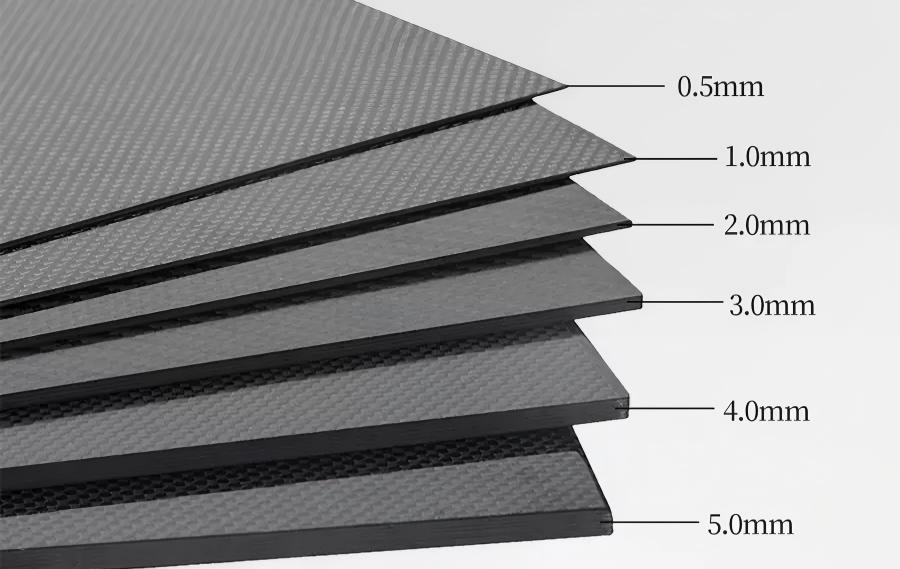
Los «genes» del prepreg determinan el estándar de referencia para los laminados
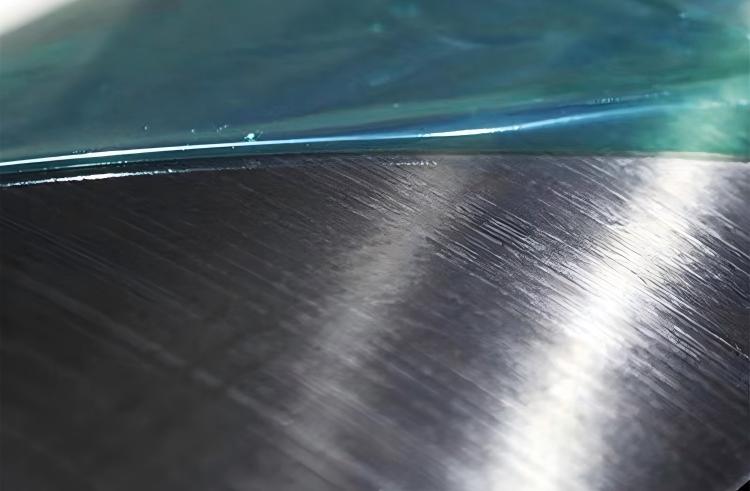
Como materia prima de los paneles de fibra de carbono, las propiedades físicas del prepreg determinan directamente su espesor y su planicidad.
1. El peso areal de la fibra (FAW) determina el espesor teórico
El peso base de la fibra del prepreg es el parámetro clave para controlar el espesor. Tomando como ejemplo el prepreg unidireccional, una capa individual con un peso base de 50 g/m² tiene un espesor de aproximadamente 0,05–0,06 mm, mientras que una con un peso base de 200 g/m² alcanza 0,19–0,20 mm. La elección del peso base del prepreg determina directamente el valor teórico de referencia del espesor del panel final.
Los prepregs delgados ofrecen ventajas significativas en cuanto al control de la planicidad. Estudios han demostrado que, en comparación con los prepregs convencionales (200 g/m²), los prepregs delgados (por ejemplo, de 50 g/m²) permiten una impregnación más sencilla y presentan una permeabilidad superior debido al menor espesor de las capas individuales de fibra. En estructuras laminadas, las burbujas de aire se expulsan con mayor facilidad entre las capas de prepreg delgado, lo que resulta en una cantidad notablemente menor de poros y fibras más rectas. Esto no solo facilita el control de la precisión del espesor, sino que también mejora la planicidad superficial y las propiedades mecánicas.
2. El papel regulador del contenido de resina (RC)
El contenido de resina de los prepregs suele oscilar entre el 35 % y el 42 % en peso. Este parámetro afecta directamente el comportamiento de flujo durante la curado y el espesor final:
RC alto (42 % o más): Buena fluidez; tras el curado, la superficie presenta una capa rica en resina gruesa y una apariencia atractiva. Sin embargo, si la presión no se controla adecuadamente, el exceso de resina que rebosa puede provocar fácilmente un espesor insuficiente y huecos entre las capas.
RC bajo (35 %–38 %): Alta fracción volumétrica de fibra y buena resistencia, pero fluidez insuficiente. Esto puede dar lugar a huecos en las esquinas y en los refuerzos de nervaduras, afectando la planicidad superficial.
3. Preocupaciones sobre el contenido de sustancias volátiles
Los disolventes y la humedad residuales en el prepreg formarán burbujas durante el curado. Los prepregs de alta calidad deben tener un contenido volátil inferior al 1,5 %, mientras que los de baja calidad pueden alcanzar el 3 %. Las piezas moldeadas con dichos prepregs presentan numerosos microagujeros en la superficie y vacíos entre capas, lo que afecta gravemente su planicidad.
4. Impacto de la estructura del tejido
Los prepregs de tejido se clasifican en tres tipos según el patrón de entrelazado: entrelazado liso, entrelazado sarga y entrelazado satén. El entrelazado liso presenta malas propiedades de colocación y una alta tasa de curvatura de fibra; el entrelazado satén ofrece buenas propiedades de colocación, pero una baja tasa de curvatura de fibra; y el entrelazado sarga se sitúa entre ambos extremos. Las diferencias en la estructura del entrelazado afectan la densidad del laminado y su rendimiento en la eliminación de gases, lo que a su vez influye en la uniformidad del espesor.
Diseño del pavimento: la primera línea de defensa para lograr planicidad
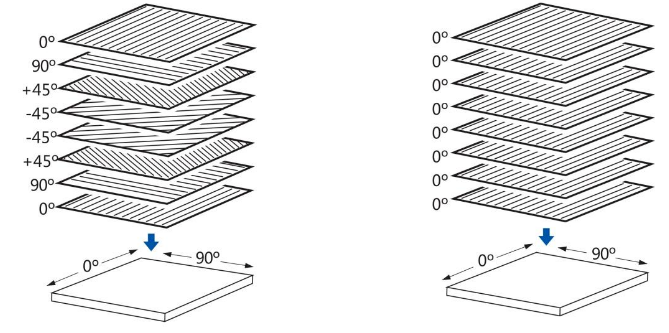
1. El apilado simétrico es la regla de oro para prevenir la deformación
Los ángulos de colocación suelen establecerse en 0°, ±45° y 90°, y se combinan según los requisitos de carga. Tras el curado, las secuencias asimétricas pueden experimentar deformación acumulada debido a diferencias en los coeficientes de dilatación térmica y en las tasas de contracción durante el curado (aproximadamente 0,02–0,05 mm/m), lo que provoca alabeo. El método de verificación más sencillo consiste en doblar la secuencia de capas por la mitad desde su centro y comprobar si los ángulos de las capas de ambos lados son imágenes especulares entre sí; si no lo son, la disposición debe reordenarse.
2. El arte de las uniones sin solapamiento y con solapamiento
Al unir paneles de gran tamaño, el ancho de solapamiento debe ser como mínimo de 10 mm. Las uniones a tope (en las que las juntas no se solapan) pueden provocar defectos similares a ranuras y concentraciones de tensión en las juntas tras el curado. Al unir múltiples capas, las juntas de capas adyacentes deben desplazarse al menos 50 mm para evitar que todas las juntas coincidan en la misma ubicación.
3. Precompactación: la clave para eliminar burbujas de aire y variaciones de espesor
Una vez finalizada la colocación de capas, la precompactación es un paso crítico para controlar el espesor y la planicidad. Durante la colocación de prepregs, el aire queda atrapado entre las capas; como la resina epoxi es altamente viscosa, no todo el aire puede escapar durante el curado térmico, lo que genera poros.
En la producción real, una vez finalizada la colocación de capas, la compactación se logra mediante rodillos compactadores o prensado en frío para comprimir firmemente las capas de prepreg de fibra de carbono , resolviendo eficazmente el problema de entrada de aire durante la colocación de capas. Una precompactación insuficiente impide que el aire escape durante el curado, lo que provoca poros o burbujas que no solo comprometen la uniformidad del espesor, sino que también afectan la planicidad superficial.
Curado en molde: la etapa decisiva para el espesor y la planicidad
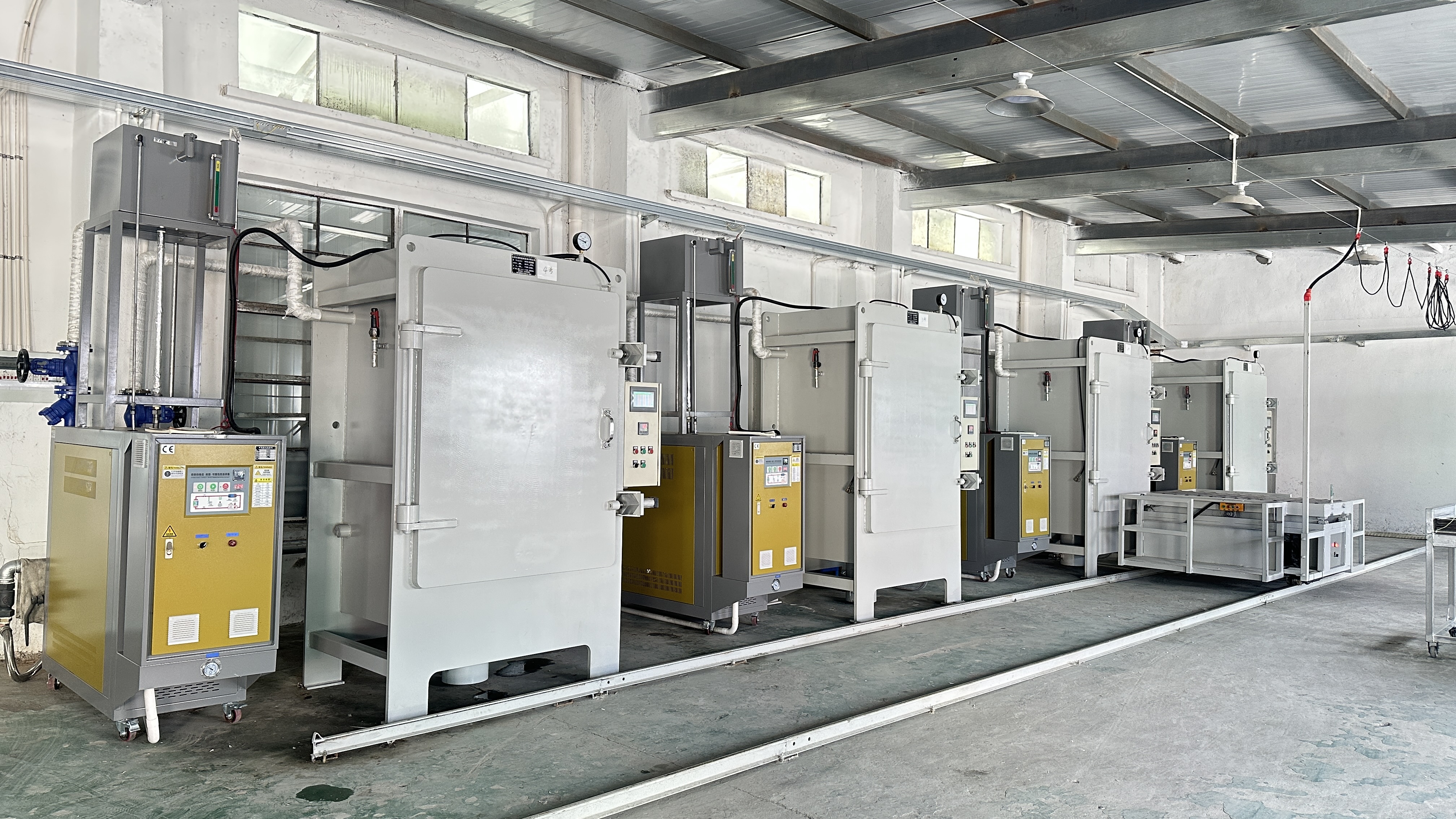
1. Presión de moldeo: el factor principal que causa deformaciones
Los estudios han demostrado que, entre los parámetros del proceso de moldeo por compresión, los factores que afectan la deformación, en orden de importancia, son: presión de compresión (P), velocidad de cierre (v), tiempo de mantenimiento (t) y temperatura de moldeo (T), siendo la presión de compresión el factor más significativo que influye en la deformación.
La presión de moldeo para los prepregs suele ser únicamente de 0,5 a 3 MPa, mucho menor que los 10 a 20 MPa requeridos para el moldeo de SMC. La presión debe seleccionarse con precisión:
Presión excesiva: se exprime demasiada resina, lo que provoca una deficiencia de resina entre capas, reduce la resistencia al corte y da lugar a un espesor de pared menor.
Presión insuficiente: no se eliminan los poros entre capas, lo que resulta en un espesor de pared mayor y una uniformidad deficiente.
el intervalo óptimo para la mayoría de las piezas de prepreg de 3K es de 1 a 1,5 MPa; cada vez que se cambie a un nuevo prepreg, se recomienda fabricar primero tres especímenes de prueba para verificar la presión.
2. Temperatura del molde y velocidad de calentamiento
La temperatura del molde suele estar entre 120 y 150 °C. La velocidad de calentamiento debe controlarse cuidadosamente:
Si la velocidad de calentamiento es demasiado rápida (superior a 8 °C/min), la resina se gelificará antes de que su viscosidad haya tenido tiempo de alcanzar su punto más bajo, lo que provocará una mala adherencia entre capas y posibles defectos superficiales, como manchas blancas o exceso de resina.
Si la temperatura aumenta demasiado lentamente: los ciclos de producción se alargan, incrementando los costos.
3 °C/min es un punto de partida seguro. Durante el proceso de moldeo, se puede ajustar la potencia de calentamiento para garantizar que el aumento de temperatura del molde permanezca dentro de un rango adecuado (sin superar ±5 °C).
3. Temporización precisa de la aplicación de presión
El momento de aplicar la presión aplicación durante el proceso de curado es crítico:
Aplicar presión demasiado pronto: desbordamiento excesivo de resina, bajo contenido de resina y reducción de la resistencia al corte interlaminar.
Aplicar presión demasiado tarde: la resina ya ha comenzado a endurecerse, dificultando el mantenimiento del espesor deseado; un alto contenido de resina reduce la resistencia a la flexión.
El momento de aplicación de la presión no debe determinarse únicamente según las propiedades termoestables del sistema de resina; la decisión debe tomarse considerando las condiciones reales del proceso.
4. Relación entre el tiempo de mantenimiento de la presión y el espesor
El tiempo de curado de los prepregs se calcula en función del espesor, normalmente 1–2 minutos por milímetro de espesor. Una pieza de 2 milímetros de espesor requiere 2–4 minutos de mantenimiento de la presión; sin embargo, este tiempo se mide una vez que la temperatura del molde ha alcanzado su estabilidad, no desde el cierre inicial del molde. El calentamiento del molde desde la temperatura ambiente lleva una cantidad considerable de tiempo y debe medirse mediante un termopar ubicado en el interior del molde.
5. Enfriamiento y desmoldeo
Una vez finalizado el curado, permita que el producto se enfríe hasta 50 °C o menos antes del desmoldeo, para minimizar la deformación causada por la contracción de la resina y garantizar la consistencia entre lotes.
Copyright © 2026 Zhangjiagang Weinuo Composites Co., Ltd. Todos los derechos reservados
 EN
EN